The Downtown Design Review Board of Seattle has approved the preliminary design of BioMed Realty’s Denny Park South development. The two-tower project is slated to encompass 616,000 square feet of life science laboratory and office space. The Board also allowed the developer to submit its master-use permit for a full build-out.
The firm purchased the entire city block in April 2022 for $126.8 million, with the intent to demolish the existing structures and conduct excavation for new building foundations. BioMed tapped Perkins & Will for the project’s architectural design, while Turner Construction will provide contracting services. For engineering, urban planning and infrastructure considerations, the developer is consulting with KPFF, Site Workshop, MacDonald-Miller, Hargis/Cochran and Rushing and OAC.
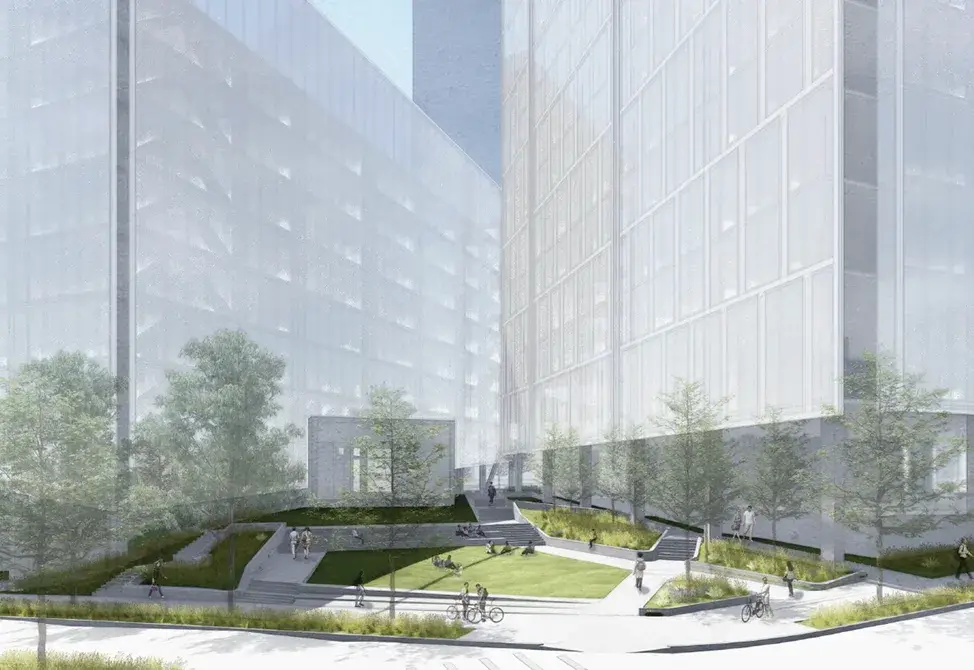
Spanning 1.6 acres along Denny Way and Dexter Avenue, the project will be built over two parcels at 2300 Seventh Ave. and 2301 Eighth Ave. The first structure is set to be an 18-story tower and the second one an 11-story connection. The developer plans to include a lawn for public events, a small forest between the two towers and a 600-stall underground parking garage.
Mike Ruhl, vice president of leasing at BioMed, further detailed the project’s utility to Commercial Property Executive, within both the proposed buildings and the surrounding area. “Our proposed 690,000-square-foot Denny Park South development will provide additional optionality for tenants seeking purpose-built buildings to accommodate research. The 1.6-acre property is in close proximity to industry-leading life science and technology companies and research institutes,” Ruhl explained.
Situated within a mile of downtown Seattle, the facility will be within walking distance of many of the area’s top retail, dining and hospitality offerings, in addition to several of the developer’s ongoing and completed life science projects around the city, such as the T6 Innovation Center, a 540,000-square-foot research & development project.