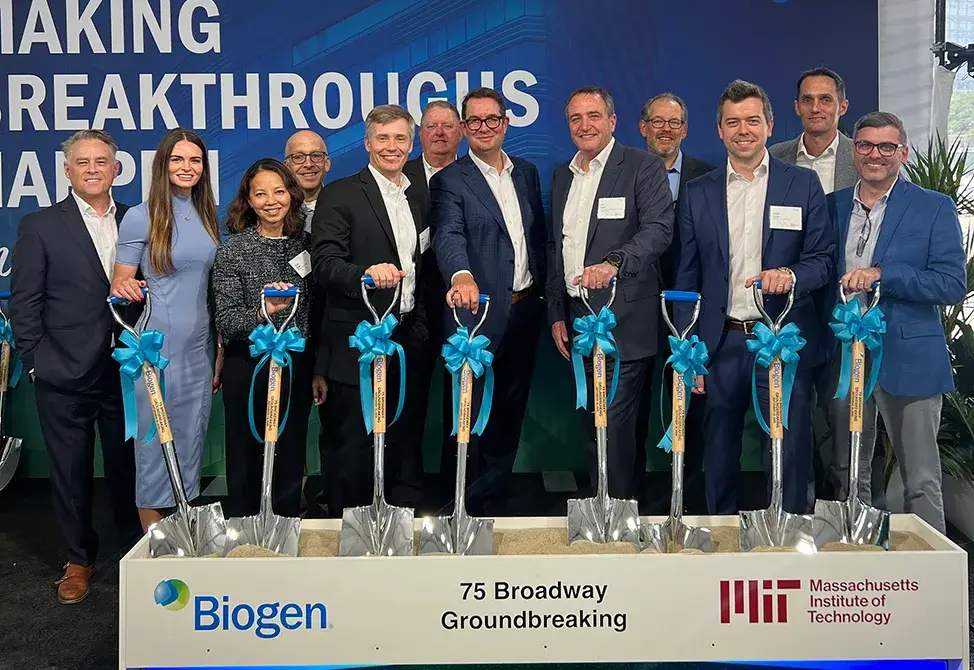
Cambridge, MA — BioMed Realty, a Blackstone portfolio company and the largest private operator of life science real estate, joined the Cambridge, MA, community on September 16 to celebrate the ceremonial groundbreaking of 75 Broadway, Biogen’s new global headquarters in Kendall Square.
The 585,000 square foot development, fully pre-leased to Biogen, represents the first new building to rise within Kendall Common, MIT’s 10-acre mixed-use redevelopment of the former Volpe site. Designed by Elkus Manfredi Architects, the state-of-the-art facility will consolidate Biogen’s operations and strengthen its nearly five-decade legacy of advancing breakthrough medicines from its Cambridge base.
Bill Kane, BioMed Realty’s President, East Coast and UK Markets, said: “Today’s groundbreaking for Biogen’s new global headquarters marks a truly significant event. This building, the first in the Kendall Common, will be a physical symbol of the pioneering spirit and scientific innovation that define Biogen. We are thrilled to partner with MIT in this world-class development project and celebrate this milestone as Biogen prepares to open this new headquarters in 2028, coinciding with their 50th anniversary.”
Jacob Werner, Co-Head of Americas Acquisitions at Blackstone Real Estate, said: “This development reflects our continued commitment to lab office investments in premier life science markets, such as Cambridge, MA. We are excited to partner with MIT to deliver prime, purpose-built space for Biogen’s critical research.”
The groundbreaking event drew nearly 300 attendees, including Massachusetts Governor Maura Healey, who underscored the state’s life sciences innovation:
“Massachusetts science saves lives — saves lives here, saves lives around the world. Today, Biogen is not just building a new facility, they are building the future of medicine and innovation.”
With construction now underway and expected completion in 2028, 75 Broadway will anchor Kendall Common with cutting-edge laboratory and office space, integrating sustainable design and conservation features.
During the groundbreaking event, MIT President Sally Kornbluth said: “We’re thrilled that Biogen chose Kendall Common’s first building for its new home. And, not incidentally, we’re deeply grateful to our joint venture partner, BioMed Realty, who helped to make this initiative possible. I look forward to continuing our shared endeavor of advancing the future of health, science and innovation.”
This milestone builds on the continued investment from BioMed Realty and Blackstone in Cambridge, where its portfolio has grown to 9.7 million square feet of operating, in-process development, and future development projects — reinforcing its role as a long-term partner to the region’s innovation ecosystem.